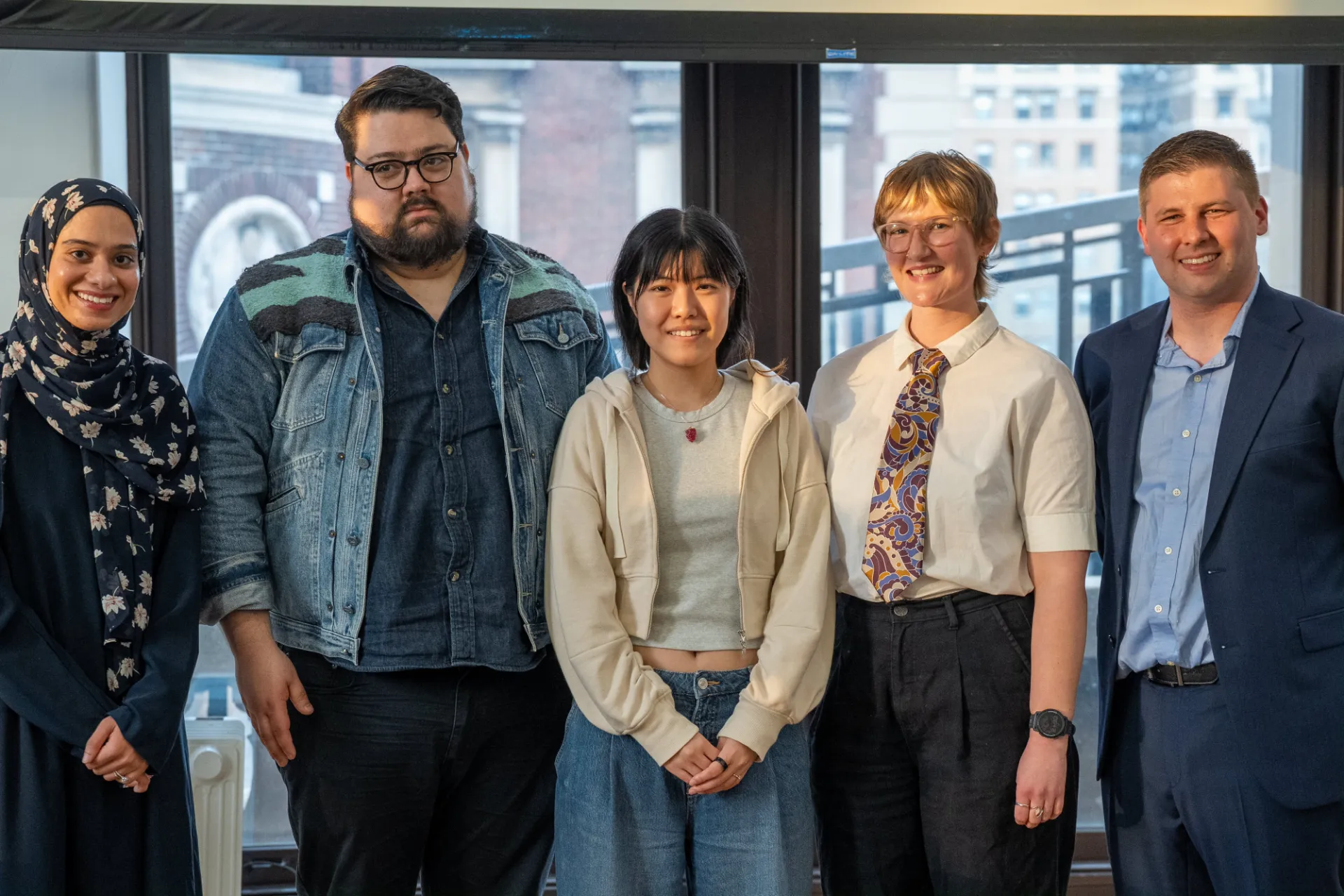
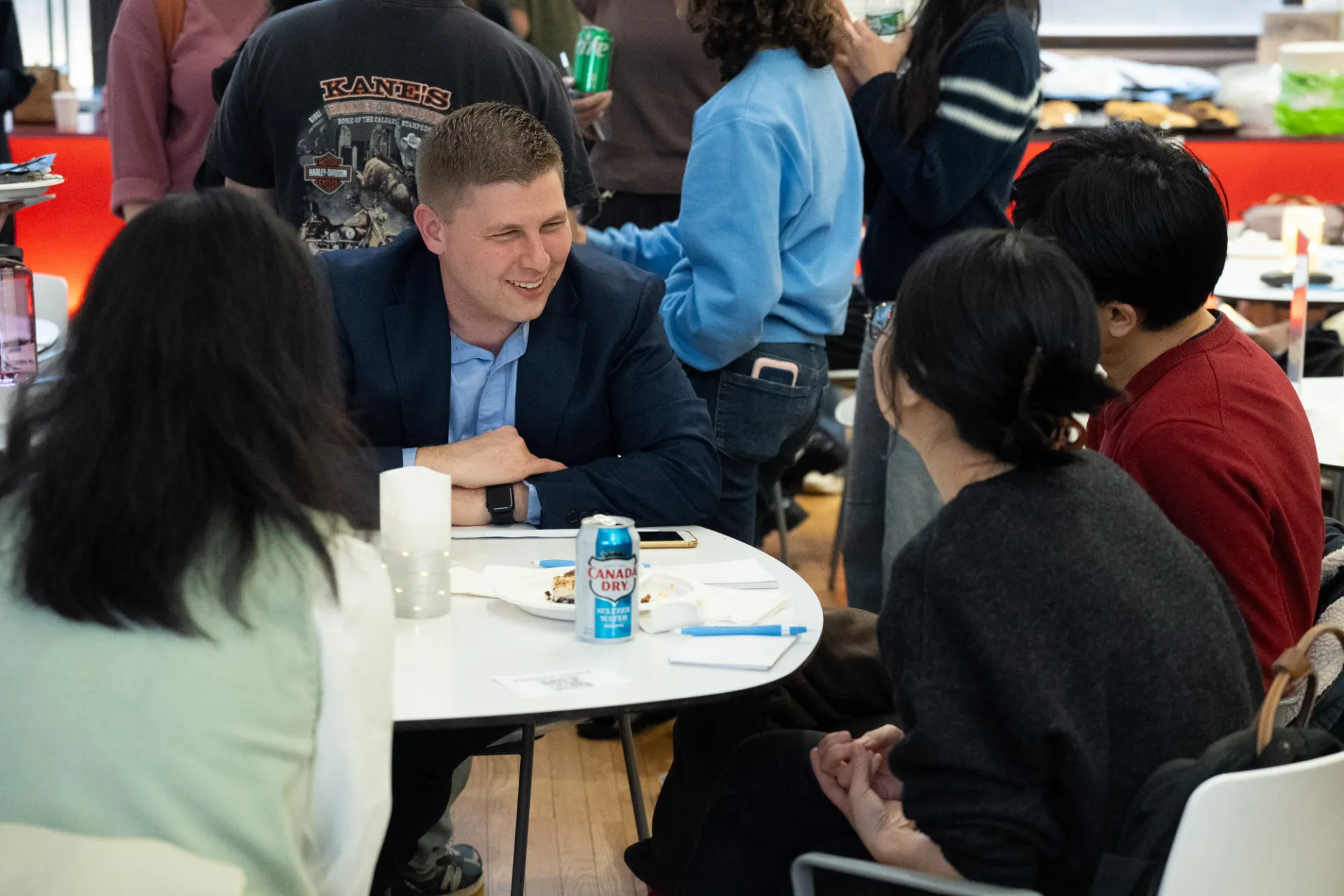
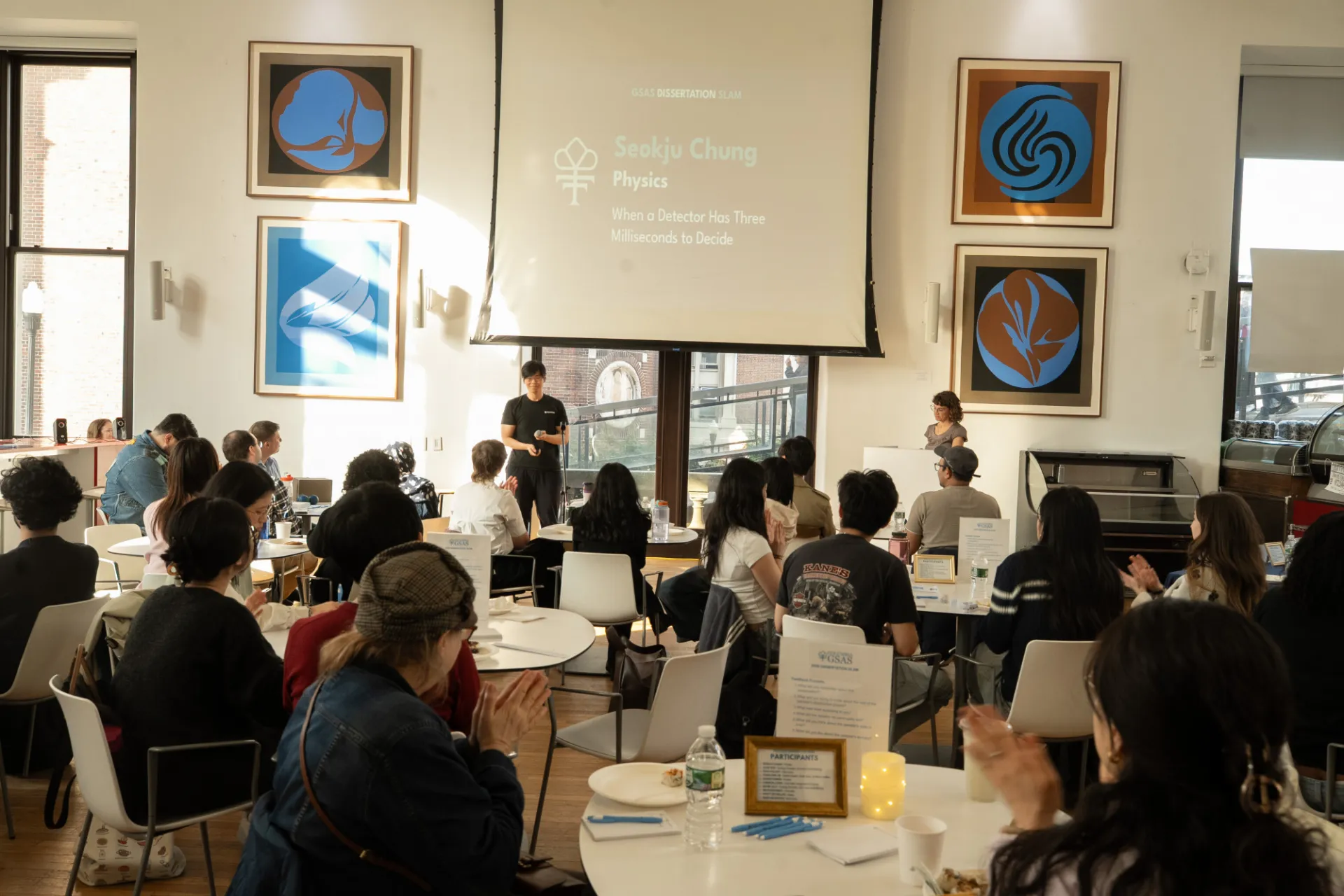
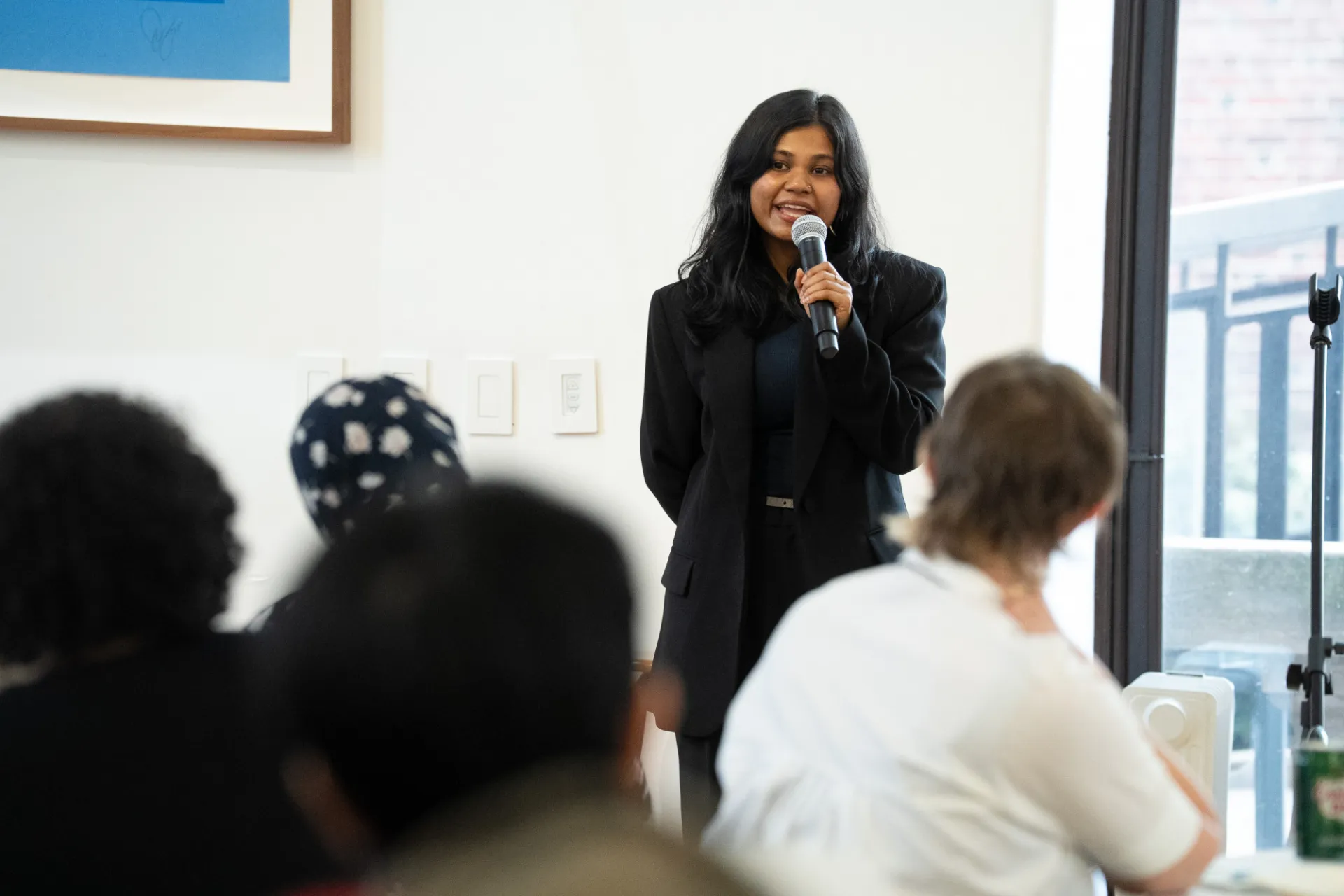
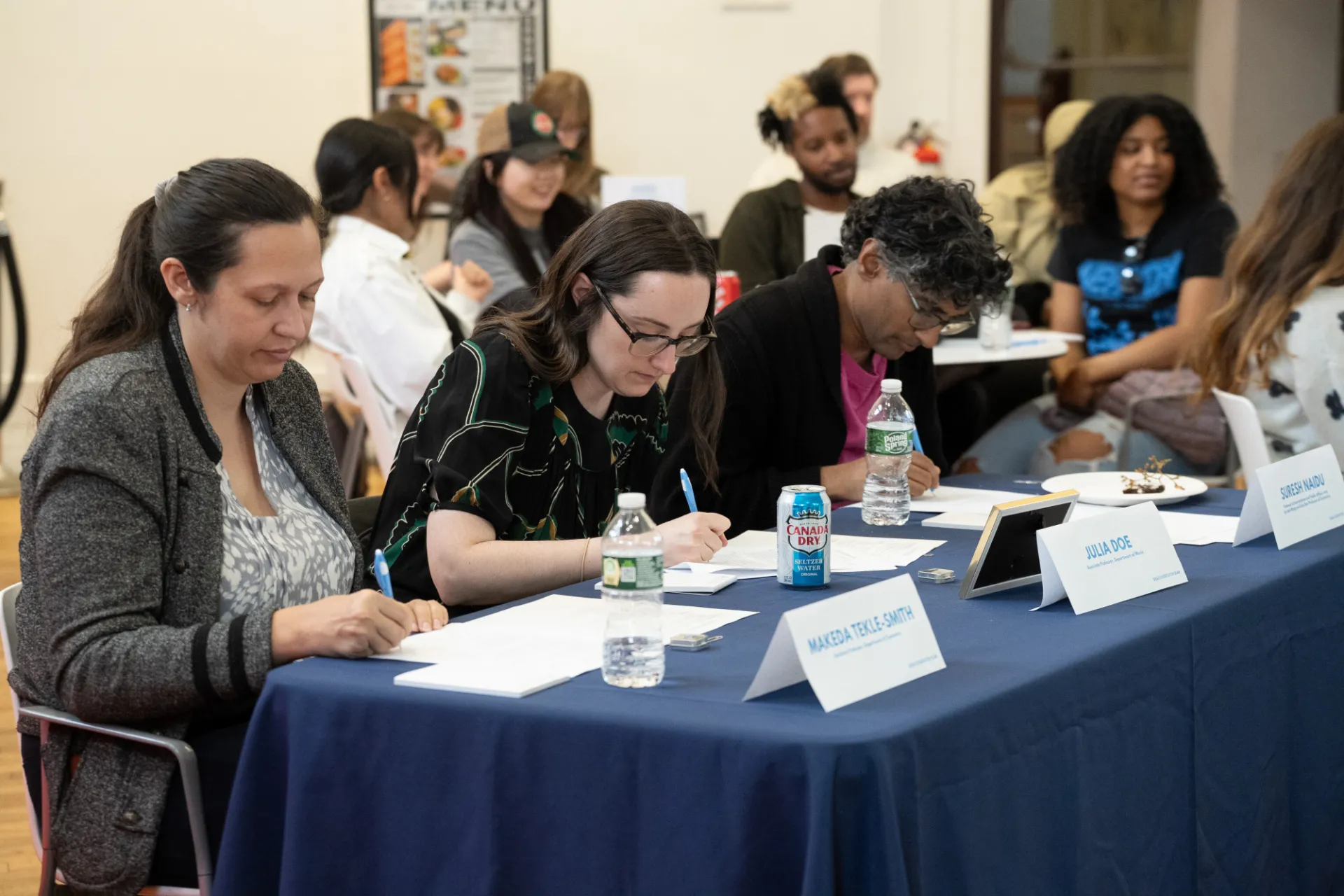
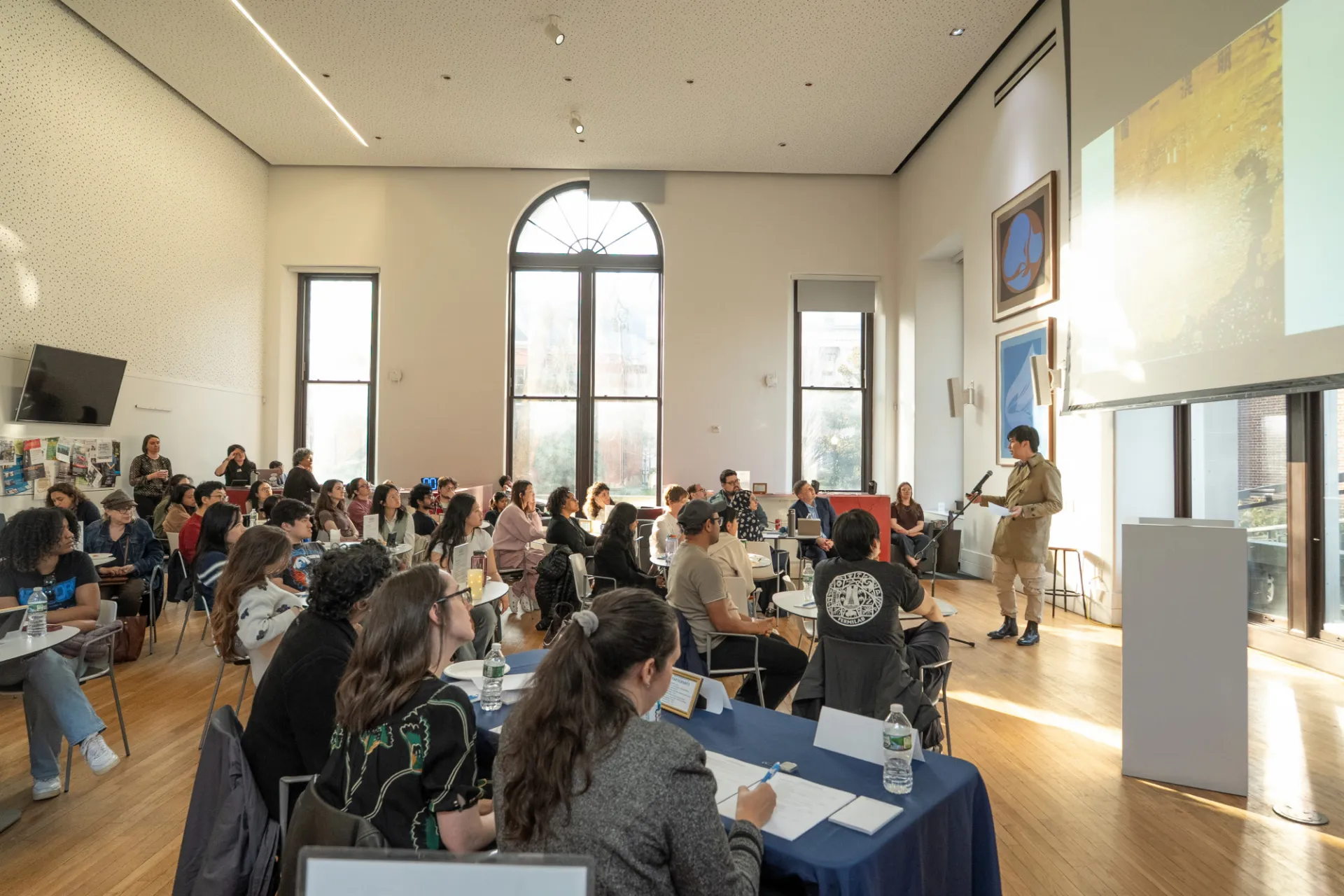
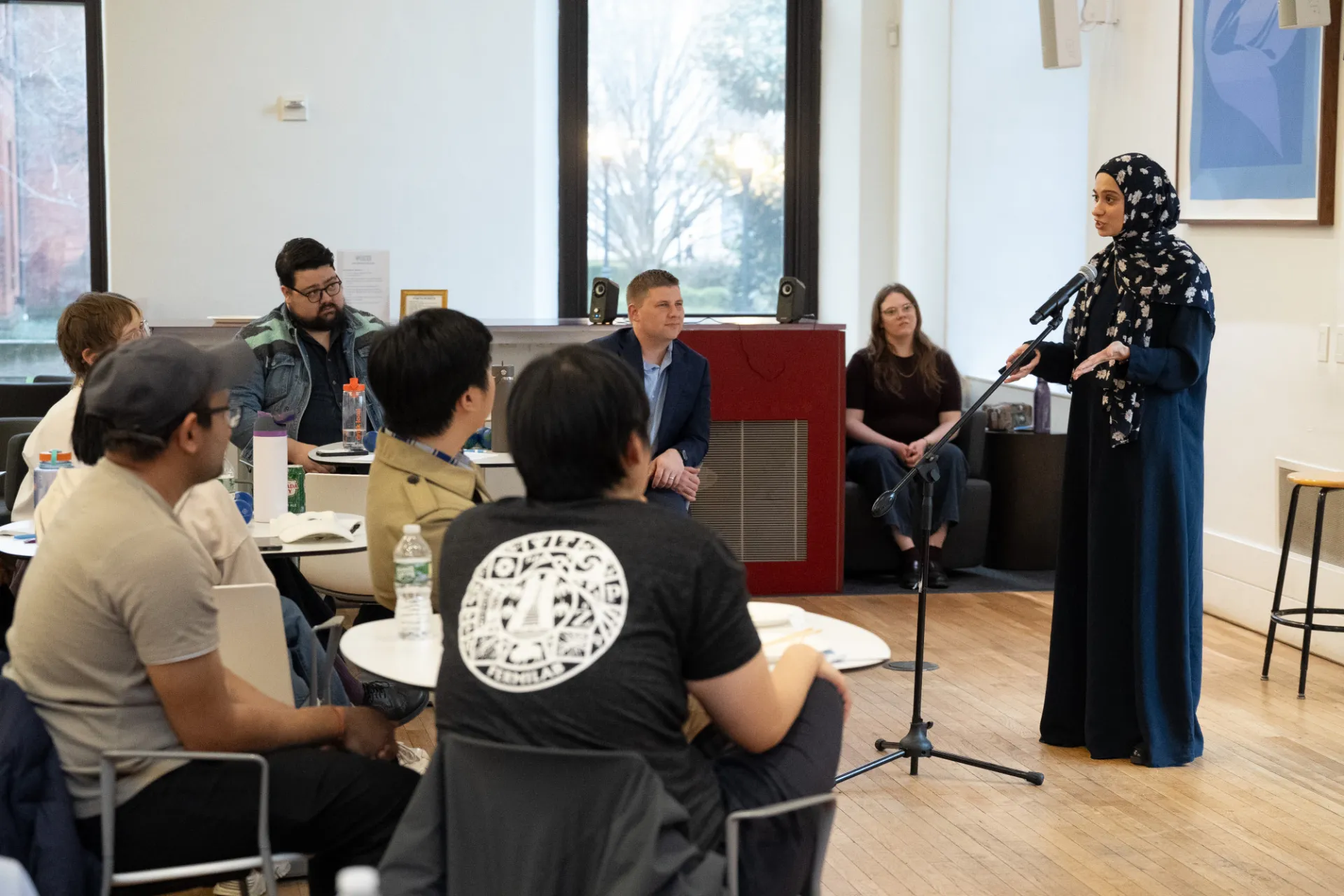
On March 30, 2026, graduate students gathered in Nous Café for the first GSAS Dissertation Slam. In three minutes, eleven advanced PhD students shared their dissertation research using props, PowerPoints, and drawings in front of a panel of faculty judges and an audience of fellow students. Organized jointly by the GSAS Compass Graduate Career & Professional Development Office and the GSAS Writing Studio, the event was an opportunity for students to hone their public speaking skills and learn how to communicate their research to a general audience. Participants were judged based on clarity of content, audience engagement, delivery, and their ability to communicate the impact of their research.
Participants readied for the event with the support of Compass and Writing Studio staff, who offered preparatory seminars and resources for public speaking, and encouraged them to practice with friends, partners, and classmates. “I tried to think about what my grandma would want to know,” said Marie Lilly (Ecology, Evolution, and Environmental Biology), while Ryan Golant (Astronomy) said he practiced in front of his cat. Students said that the trickiest part of preparing their presentation was avoiding jargon, and figuring out how to explain the real-world stakes of their subject matter. They also appreciated the opportunity to share their work with a broader audience. “I was really excited to connect stars to people,” said Maryum Sayeed (Astronomy).
When asked about his own approach to sharing his research, Wyatt Reynolds (History) quoted his advisor: “When you're speaking to the public, you cease to be an academic and you become a storyteller.” Now more than ever, GSAS is dedicated to helping students render their scholarship accessible, engaging, and resonant both within and beyond the academy.
Winners
Crismon Lewis (East Asian Languages and Cultures) presented Why Inscribe? Bronze Inscriptions and the Beginnings of Early Chinese Literature.
Marie Lilly (Ecology, Evolution, and Environmental Biology) presented Ticks in the City: Socio-ecological Dynamics of Tick-borne disease.
Maryum Sayeed (Astronomy) presented Rebels of the Night Sky.
Audience Choice Awardees
Julie Gan (Ecology, Evolution, and Environmental Biology) presented Plants Don't Like Weather Variability.
Wyatt Reynolds (History) presented We Are Forever: Indigenous Intellectual Warfare and the Coalition that Fought to Remain.
Participants
Seokju Chung (Physics) presented When a Detector Has Three Milliseconds to Decide.
Ryan Golant (Astronomy) presented The Turbulent Origins of Our Universe’s Magnetic Fields.
Yuanlong He (Middle Eastern, South Asian, and African Studies) presented A Chinese Perception of Africa.
Karan Kumar (Physics) presented Chasing a Mysterious Neutrino Signal.
Meghana Maiti (Chemistry) presented Reprogramming Protein Synthesis.
Judges
Julia Doe, Associate Professor, Department of Music
Suresh Naidu, Professor of International and Public Affairs and the Jack Wang and Echo Ren Professor of Economics
Makeda Tekle-Smith, Assistant Professor, Department of Chemistry